
Building a New Business Engine Before Q4
What happened when a room full of agency leaders stopped talking about leads and started talking about growth.
Every year, agency leaders find themselves in exactly the same position. Summer arrives, client work is still flowing and the pipeline feels healthy enough that new business slips down the priority list. There are projects to deliver, holidays on the horizon and plenty of reasons to tell yourself you'll focus on growth properly once everyone is back in September. Then September arrives, Q4 suddenly feels very real and everyone starts asking the same questions. Where are the next opportunities coming from? Is the pipeline strong enough? Should we be doing more outreach? By then, you're reacting instead of planning.
That was the thinking behind Summer Reset, a workshop we recently hosted with The Alliance of Independent Agencies. We deliberately kept it small, bringing together a group of agency founders, commercial leaders and growth specialists for an afternoon of practical discussion. Rather than filling the agenda with keynote presentations, we wanted people to challenge each other's thinking, share what was and wasn't working, and leave with a clearer idea of what their own business needed to focus on before Q4.
What struck me most wasn't anything that appeared on a slide. It was how quickly the conversation became honest.
One attendee admitted, "I keep equating new business with sales... as soon as someone says sales to me, I just think, 'I'm not a salesperson.'" Judging by the nods around the room, it clearly wasn't an isolated feeling. For many agency leaders, sales still feels like something separate from the work they love doing. They're brilliant at solving problems, building relationships and growing existing clients, but prospecting still carries baggage. It feels uncomfortable.
That's exactly why we started with mindset rather than tactics.
Most agencies don't have a lead problem
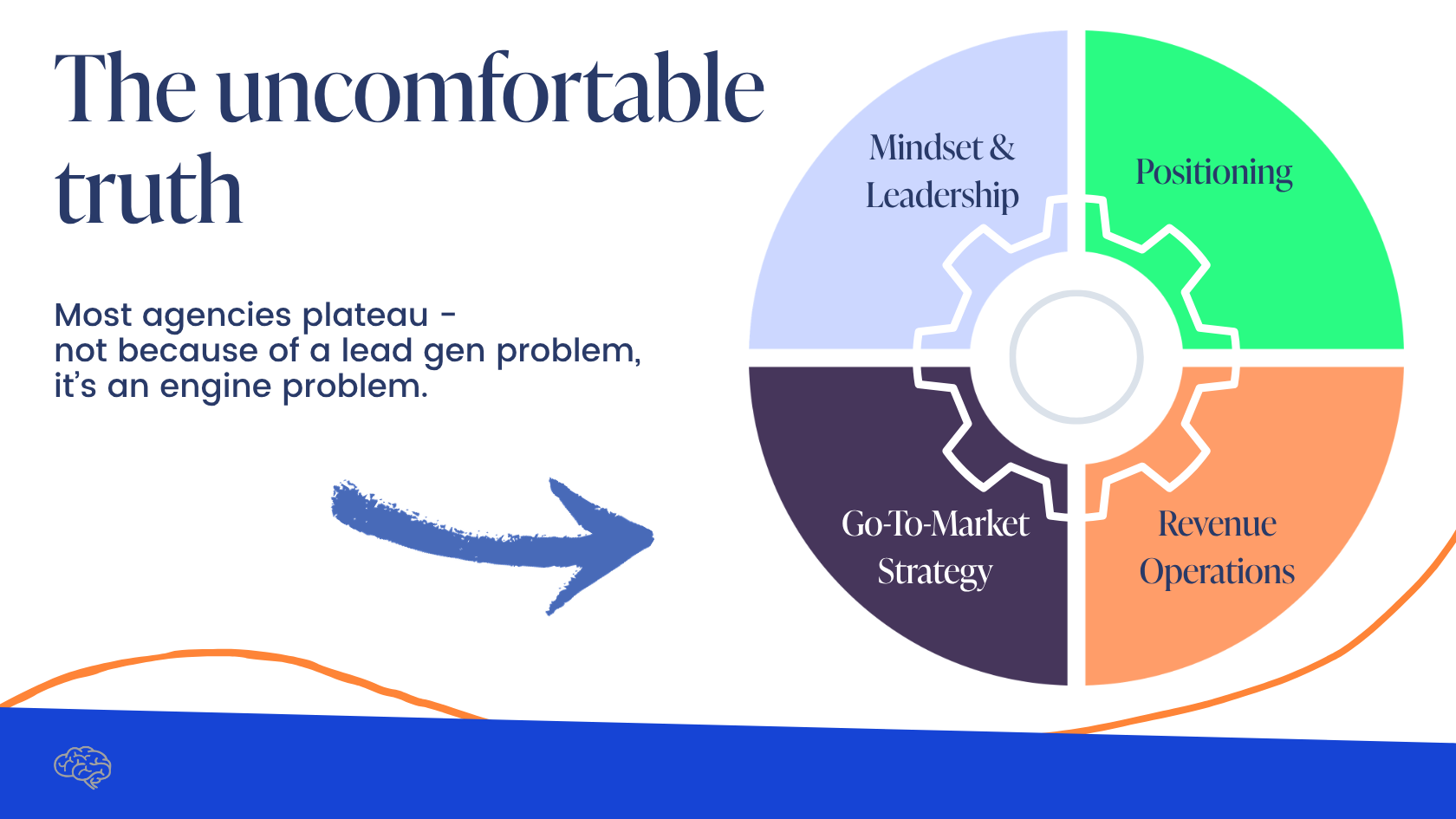
One of the ideas we've been developing at Gray Matters over the last year is that most agencies don't actually have a lead generation problem. They have an engine problem.
When agencies say they need more leads, they're usually describing the symptom rather than the cause. Somewhere in the business, the commercial engine isn't firing properly. Perhaps the positioning isn't clear enough. Perhaps marketing and sales are operating independently. Perhaps opportunities aren't being followed up because everyone is focused on client delivery. As we discussed during the workshop, "Most people talk about the problem, not the cause of the problem. The problem is we don't have enough leads. What's causing that problem is that you don't have an engine."
That shifts the conversation completely. Instead of immediately asking how to generate more leads, you begin asking much better questions. Do people understand what makes us different? Are we giving them a compelling reason to choose us? Are we consistently creating opportunities, following them up and learning from every conversation? Leads are simply the output of those things working together.
The other point we kept coming back to was timing. New business has a lag. The work you do today rarely becomes revenue next month. Relationships take time to build, opportunities take time to develop and buying decisions take time to make. That's why Summer Reset exists in the first place. As I said on the day, "If you do this thinking in September, you're not getting anything off the ground before Christmas." The best time to build momentum is before you need it.
Story + System
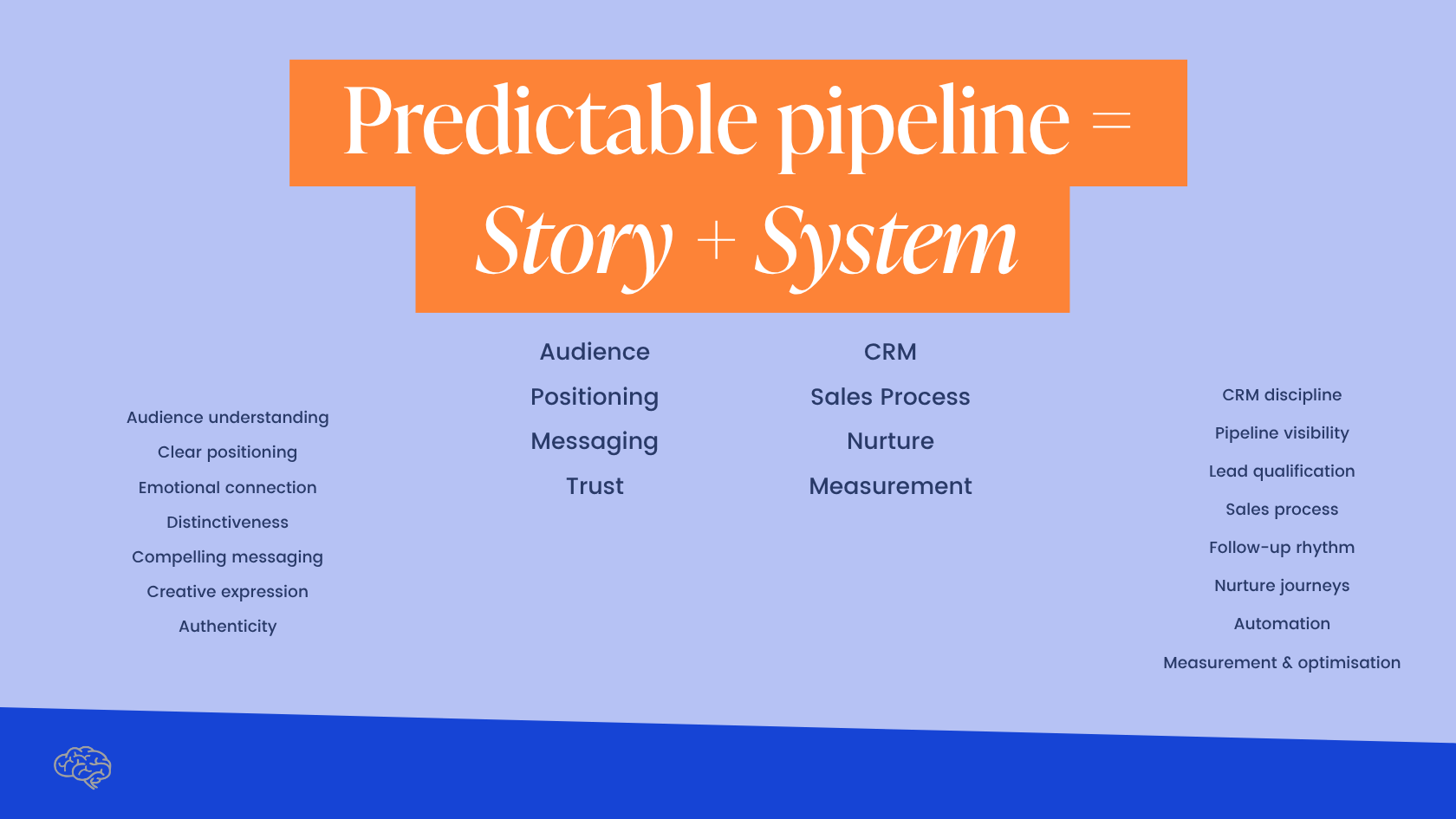
That naturally led into a framework we've been refining over the past year called Story + System.
Story is everything your prospects experience before they've even spoken to you. It's your positioning, your messaging, your personality, your point of view and the emotional connection people make with your business. System is everything happening behind the scenes. CRM discipline. Pipeline visibility. Follow-up. Nurture. Measurement. Sales process. One creates desire, the other creates consistency.
It sparked an interesting discussion because most people recognised they probably leaned more heavily towards one side than the other. Some agencies had a fantastic reputation and plenty of referrals, but very little structure behind the scenes. Others had invested heavily in CRM platforms and automation, but still struggled to articulate what made them genuinely different.
As we discussed, "You can have a weak story but an incredible system and still win business. Obviously the dream is to have both."
That simple distinction seemed to resonate because it explained something many agencies experience. You can have brilliant marketing and still struggle if nobody follows opportunities up properly. Equally, you can have a disciplined sales process, but if your proposition sounds like every other agency, you're constantly fighting to stand out. Sustainable growth comes from strengthening both sides of the equation together.
Positioning is about making choices
That conversation flowed naturally into positioning, which generated some of the liveliest debate of the afternoon.
Every agency wants to stand out, yet many still describe themselves in remarkably similar ways. Creative. Strategic. Award-winning. Full service. Experienced. None of those statements are wrong, but they've become so familiar that buyers barely notice them anymore.
Instead, we explored different ways agencies can differentiate themselves. Sometimes it's the audience they understand better than anyone else. Sometimes it's the problem they solve, the methodology they've developed or the beliefs that shape how they work. We also spent time looking at the difficult decisions that positioning demands.
The question of niching came up, as it almost always does.
How specific is too specific? What if we put people off? Should we really focus on one type of client?
It's a perfectly reasonable concern, but I still think agencies worry about it far more than they should. Becoming known for something inevitably means some people decide you're not for them. That's not a weakness. It's usually a sign your positioning is becoming clearer. The agencies that build real momentum are rarely trying to appeal to everybody. They're simply much clearer about who they're for and the change they create.
Positioning isn't about writing clever copy. It's about making commercial decisions that shape everything else.
Consistency beats intensity
The afternoon then shifted from strategy to execution, but interestingly, the themes stayed remarkably consistent.
Erez's session on lead generation wasn't really about outreach. It was about building habits. Rather than chasing more prospects, he encouraged people to make better use of the relationships they already have and to stop treating outreach as a campaign that starts and stops. As he put it, "Your goal isn't to sell. Your goal is to start a conversation."
Dan Archer picked up a similar thread from a marketing perspective. Marketing has become unnecessarily complicated. Agencies often spend huge amounts of time looking for content ideas when they're already sitting on a wealth of insight from client meetings, sales conversations and networking events. The challenge isn't finding something to say. It's building the rhythm to consistently capture those conversations and turn them into useful content.
One of Dan's observations stayed with me. "Most agencies are sitting on an absolute goldmine of commercial intelligence every week, but they're throwing it away."
That idea tied everything together. Whether we're talking about marketing, sales or business development, the challenge is rarely a lack of ideas. More often it's a lack of consistency. We all know what we should be doing. The difficult part is continuing to do it when client work inevitably gets busy.
One of the simplest slides from the day probably summed it up best.
You can't control the market. You can control your rhythm.

Great pitches begin long before the pitch
Marcus Brown closed the afternoon by talking about pitching and conversion, but in many ways he was reinforcing everything that had already been discussed.
By the time you're standing in front of a prospective client delivering a pitch, much of the decision has already been shaped. Your positioning has influenced how you're perceived. Your marketing has built familiarity. Your outreach has started the relationship and your follow-up has demonstrated professionalism. The pitch isn't where persuasion begins. It's where all of those things come together.
That's why the strongest agencies don't think about pitching as an isolated skill. They see it as the final stage of a much bigger commercial process.
Final thoughts
Looking back, what made the afternoon valuable wasn't that anybody discovered a revolutionary new tactic. It was that a room full of experienced agency leaders took the time to step away from client delivery and ask better questions about how they grow.
The conversation kept returning to the same conclusion. Sustainable growth doesn't come from one brilliant campaign, one great salesperson or one new AI tool. It comes from building a compelling story, supporting it with a repeatable system and having the discipline to keep both moving when business is busy.
That's ultimately what Summer Reset was about.
Not finding a shortcut to growth, but building a new business engine that continues creating momentum long after the workshop has finished.
Want to take our Growth Assessment or find out when our next Reset event is? Send us your details.